Proportional recommendations
NASA’s scan and the problem with mandatory-sounding AI checklists
NASA’s public snapshot returned 91/100 with an informational llms.txt note. Emerging discovery proposals should not become universal requirements.
nasa.gov · observed 2026-10-02T18:25:23.306Z
Is the recommended interface necessary for the task your website serves?
The finding in context
The saved nasa.gov assessment returned 91/100 technical readiness, high observation confidence and 58% evidence coverage. Its recorded llms-txt-not-found finding was informational. The report described llms.txt as an emerging proposal, not a universal requirement.
It would be easy to turn that line into an alarming headline. It would also be unsupported. This observation does not show that NASA is invisible to AI systems, that its public information cannot be retrieved or that it needs a transactional agent interface. A missing optional file is a narrow observation.
Start with the task, not the checklist
A public-information site serves different tasks from a paid API or a storefront. Readers may need accessible documents, reliable canonical links and clear provenance. They may not need machine-readable commercial quotes, payment challenges or a protocol for consequential actions.
Before recommending an additional surface, name the actual task it would improve and the audience expected to use it. Check the documentation of the relevant system rather than assume every emerging proposal is a requirement. Google’s guidance for its AI search features points website operators back to normal Search eligibility and sound technical foundations, not a special AI-only markup requirement.
Keep unknown, optional and not applicable distinct
An unknown check means the collector did not establish the fact. Optional means the signal is not universally required. Not applicable depends on the site’s intended capabilities. Those states should not be flattened into red warnings, and a public scan alone may not know enough about the operator’s goals to assign the last state confidently.
That makes a useful report partly an evidence plan. It can identify what was inspected, show why an observation might matter and describe what to verify next. It should not pressure a site into building an unused interface solely to improve a generalized score.
A proportionate next step
Run a baseline for a public hostname you operate and read the exact recommendation, including its severity and limitation. Prioritize broken or contradictory signals affecting a real audience before experimenting with optional discovery files. Preserve the original report when you retest so a changed result has a traceable context.
The commercial value of an evidence tool is not the number of warnings it produces. It is whether the operator can make a better, defensible decision. This example shows why a strong assessment can lead to a sensible monitoring decision rather than an unnecessary remediation project.
Find the evidence on your own site
Run a free public scan, inspect one specific finding, and identify the next useful check. No private account access is required for the public baseline.
Evidence and primary sources
- NASA: saved assessment and informational finding
- Google: AI features and your website
- llms.txt proposal
Observations can change. An interstitial or truncation classification can also require collector review. Submit a reproducible correction rather than treating a snapshot as a permanent company-wide verdict.
What should the next study answer?
Share a useful lesson, tell us what remains unclear, or send a reproducible question. Questions are reviewed; they do not automatically become published claims.
Continue with a related question
The BBC example: separate AI search policy from training controls
A 93/100 public snapshot with purpose-specific restrictions shows why publishers need more than an allow-all or block-all AI policy.
Read the evidence and next step →Supabase scored 100—and the scan still hit an inspection limit
Why a homepage-truncated finding belongs beside a strong score, and how to distinguish bounded technical checks from exhaustive inspection.
Read the evidence and next step →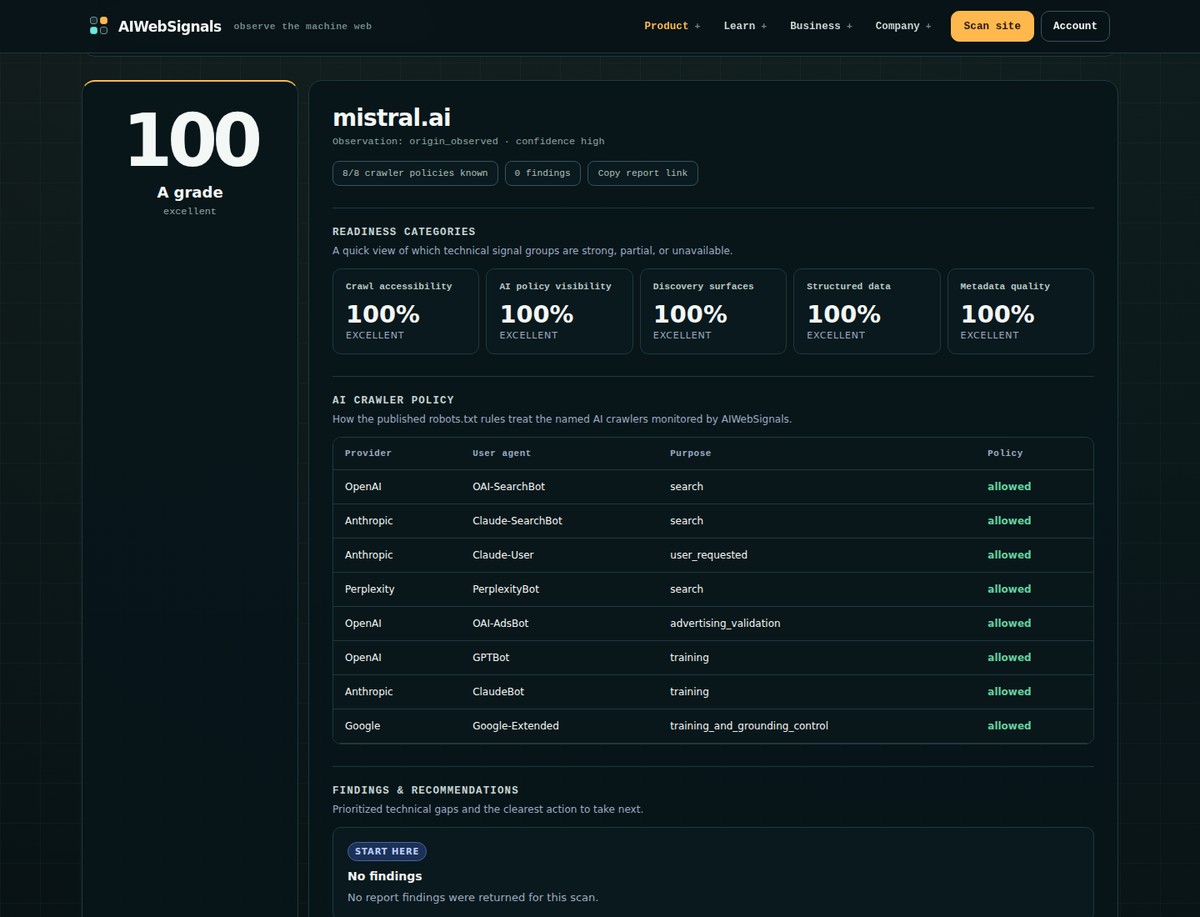
Mistral scored 100. Why was evidence coverage only 58%?
A concrete explanation of technical readiness versus evidence coverage, using Mistral’s October 2 public assessment and its 20 unknown checks.
Read the evidence and next step →