Observation boundaries
Stripe’s homepage and documentation produced different answers. Here is why that matters.
A 100/100 homepage result and a withheld documentation score show why hostname, response classification and inspection limits belong in every report.
stripe.com · observed 2026-10-02T18:21:11.075Z
docs.stripe.com · observed 2026-10-02T18:19:01.034Z
Does one homepage score describe your entire public web presence?
Read the two saved observations separately
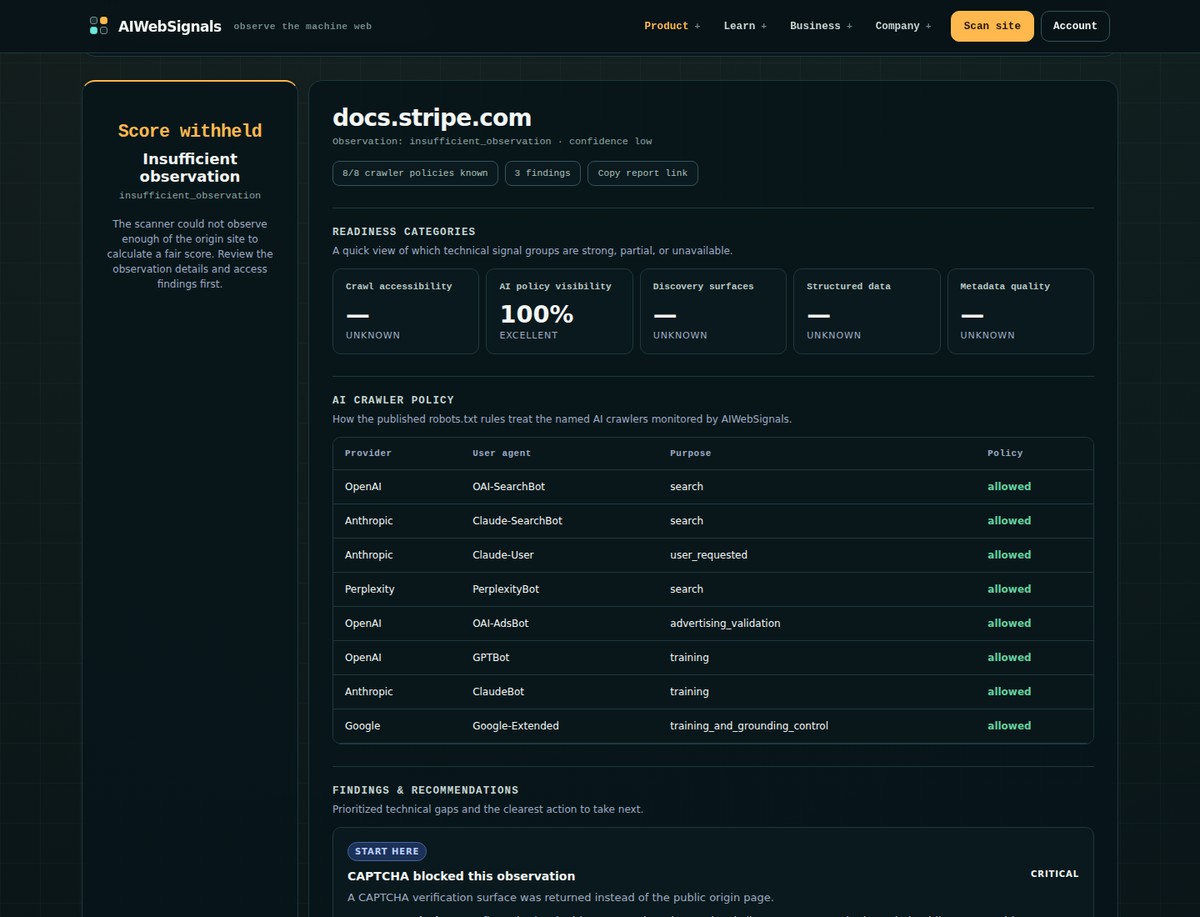
In the October 2 cohort, stripe.com returned 100/100 technical readiness and 58% evidence coverage. docs.stripe.com returned a report with its technical score withheld and 27% coverage. These were two requests to two hostnames, not two conflicting reviews of a single response.
The documentation report recorded an HTTP 200 response, a suspected-interstitial classification and a homepage-truncated note at the 786432-byte inspection limit. The classifier labeled the response captcha_challenge. That is a scanner classification requiring contextual review, not independently verified proof that a human visitor or every other agent encounters a CAPTCHA.
An HTTP success is not enough to identify the page
A successful HTTP status can carry the intended document, an access interstitial or content that an automated classifier cannot safely distinguish. A bounded collector can also stop before late-document evidence appears. The useful report records those conditions instead of converting them into a confident assessment of the entire service.
Withholding the score prevents an unsupported ranking, but it does not make the underlying classifier infallible. The correct follow-up is to review the returned content and observation method. A false-positive interstitial classifier would be a defect in our observation system, not a problem for the target organization to fix.
Apply the lesson to your own estate
Many organizations separate a marketing site, developer documentation, help center and application. Start with an inventory of the public hostnames that a prospective user or integration must discover. Assess each exact surface and its intended task. A homepage score cannot certify a documentation journey or an authenticated workflow.
For a comparison, keep time, method and applicable checks visible. Do not treat unknown fields as zero when building a matrix. If one surface is safely observed and another is not, the resulting matrix should show the missing observation and the next verification step instead of manufacturing a winner.
A useful diagnostic, not a claim of lost business
Nothing in these two snapshots demonstrates that Stripe lost traffic, that its documentation is unavailable generally, or that it needs to change its security controls. The snapshots demonstrate that our bounded public observation had different coverage on two related surfaces.
Use the comparison tool to examine your own relevant hostnames, then investigate the exact evidence behind any discrepancy. When you need to know which requests really arrive and where they fail, the next layer is operator-authorized first-party telemetry. That is a different product question from collecting more impressive homepage scores.
Compare the surfaces you actually operate
Start with your marketing, documentation or product hostnames. Compare public observations without treating unknown fields as failures.
Evidence and primary sources
Observations can change. An interstitial or truncation classification can also require collector review. Submit a reproducible correction rather than treating a snapshot as a permanent company-wide verdict.
What should the next study answer?
Share a useful lesson, tell us what remains unclear, or send a reproducible question. Questions are reviewed; they do not automatically become published claims.
Continue with a related question
Supabase scored 100—and the scan still hit an inspection limit
Why a homepage-truncated finding belongs beside a strong score, and how to distinguish bounded technical checks from exhaustive inspection.
Read the evidence and next step →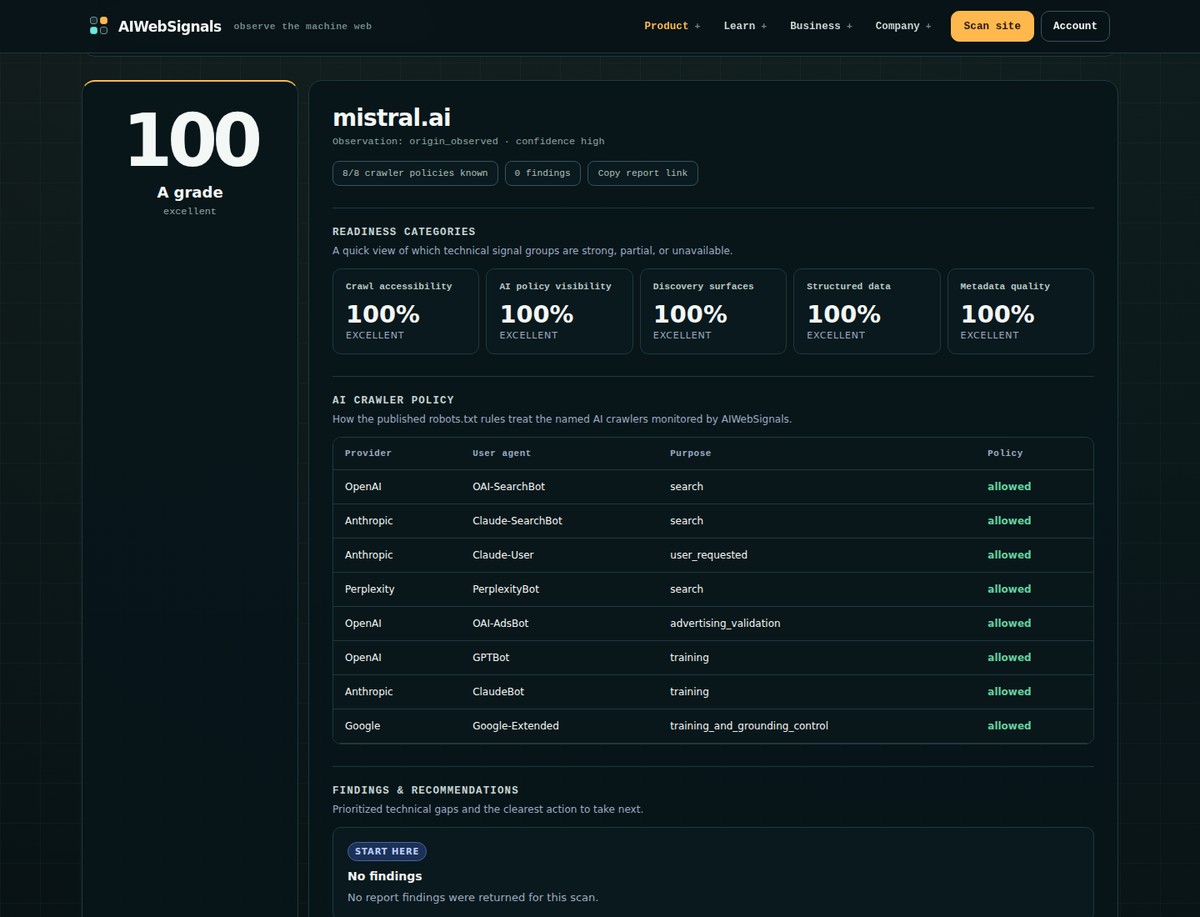
We scanned 100 websites. A score was not always an answer.
99 reports, 55 numeric scores, 44 withheld scores: what a varied public-web sample teaches about evidence, access, and useful AI-readiness assessments.
Read the evidence and next step →Mistral scored 100. Why was evidence coverage only 58%?
A concrete explanation of technical readiness versus evidence coverage, using Mistral’s October 2 public assessment and its 20 unknown checks.
Read the evidence and next step →