Commerce
What a strong consumer-storefront scan can—and cannot—tell you
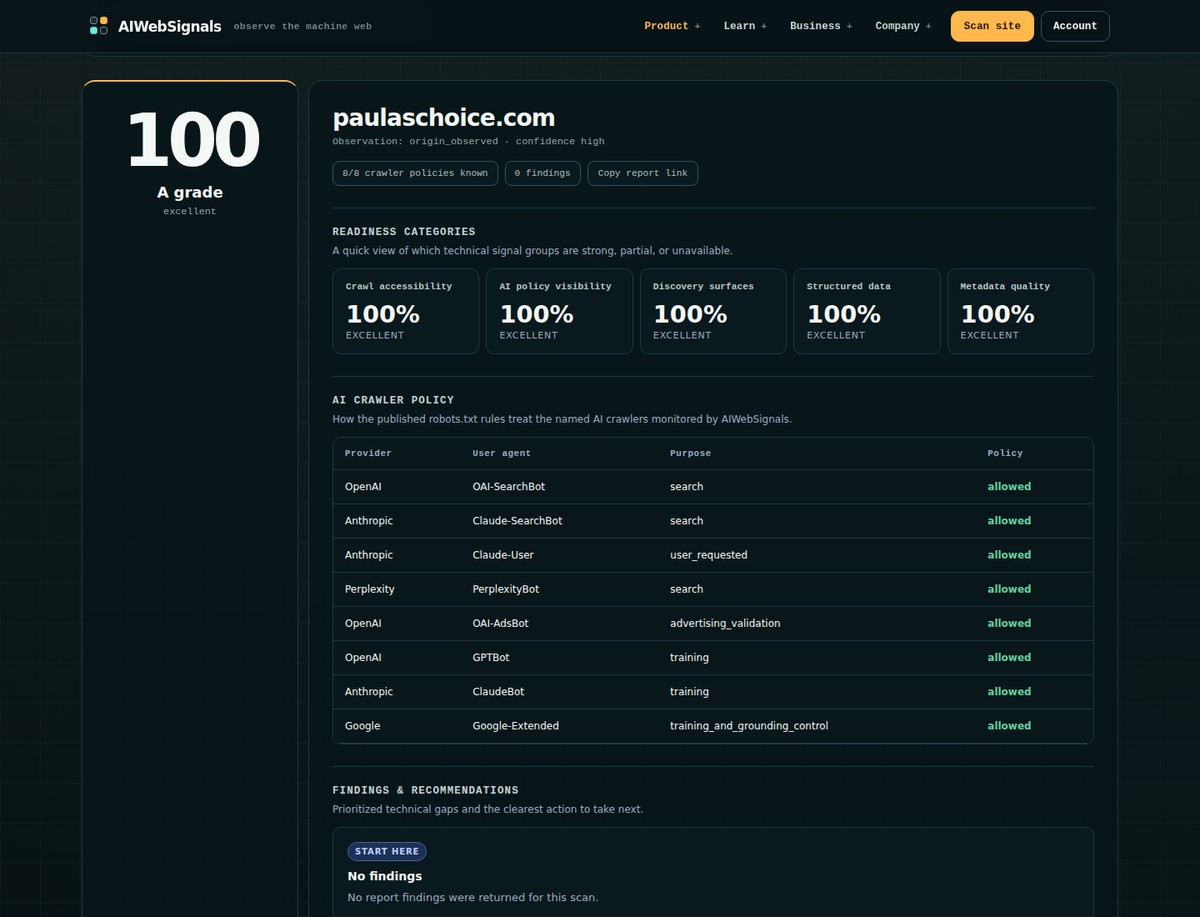
Paula’s Choice returned 100/100 in our public homepage assessment. The useful lesson for ecommerce is separating discovery from a verified shopping journey.
paulaschoice.com · observed 2026-10-02T18:22:10.591Z
Can a strong homepage result prove that a customer can complete a purchase?
A consumer example alongside the software sites
The October 2 paulaschoice.com homepage assessment returned 100/100 technical readiness with high observation confidence and 58% evidence coverage. Public discovery and structured-data checks used by the technical model were observed. This supplies a consumer-brand example rather than limiting the discussion to developer platforms.
The observation is about that homepage at that time. Paula’s Choice is not presented as an AIWebSignals customer or endorser. The report does not reveal its internal analytics, product-feed approval state, acquisition performance or customer behavior.
Discovery is the beginning of the purchase path
A prospective buyer or a shopping assistant may need to identify the brand, find a product, interpret a format, understand price and delivery, and then complete a transaction. A public homepage scan can inform the discovery layer without exercising the full purchase path.
Product-level availability, variants, shipping destinations, tax, authentication and payment confirmation need their own evidence. A JSON-LD signal on a homepage is not a receipt for a successful order. An attractive aggregate should never erase those distinctions, particularly when a report is being used to justify commercial decisions.
A practical checklist for a storefront operator
Begin with the public information a buyer must understand: what the item is, which variant the price describes, whether it is available, what delivery restrictions apply and which page is canonical. Compare machine-facing data with what the customer sees. Treat conflicting prices or formats as specific inconsistencies to verify, not proof that revenue was lost.
Then test the consequential path with appropriate authorization and a controlled test environment. Record whether an item can be selected, whether the cart preserves it, whether the shipping quote matches the destination and whether the payment system confirms the intended result. Keep a click, a checkout attempt and a confirmed paid order as distinct outcomes.
The next step should match the evidence gap
For your own storefront, the public report is a low-commitment baseline. Inspect a concrete finding and retest the same surface after a relevant change. Connected observation becomes useful when you need to compare actual machine requests with the public policies and content the scanner can see.
This case should not become a league table declaring every withheld beauty-site result inferior. Missing observation is not a judgment about product quality or business success. The stronger demonstration is a clear account of what was observed, what remains unknown and which next check could support a better decision.
Find the evidence on your own site
Run a free public scan, inspect one specific finding, and identify the next useful check. No private account access is required for the public baseline.
Evidence and primary sources
Observations can change. An interstitial or truncation classification can also require collector review. Submit a reproducible correction rather than treating a snapshot as a permanent company-wide verdict.
What should the next study answer?
Share a useful lesson, tell us what remains unclear, or send a reproducible question. Questions are reviewed; they do not automatically become published claims.
Continue with a related question
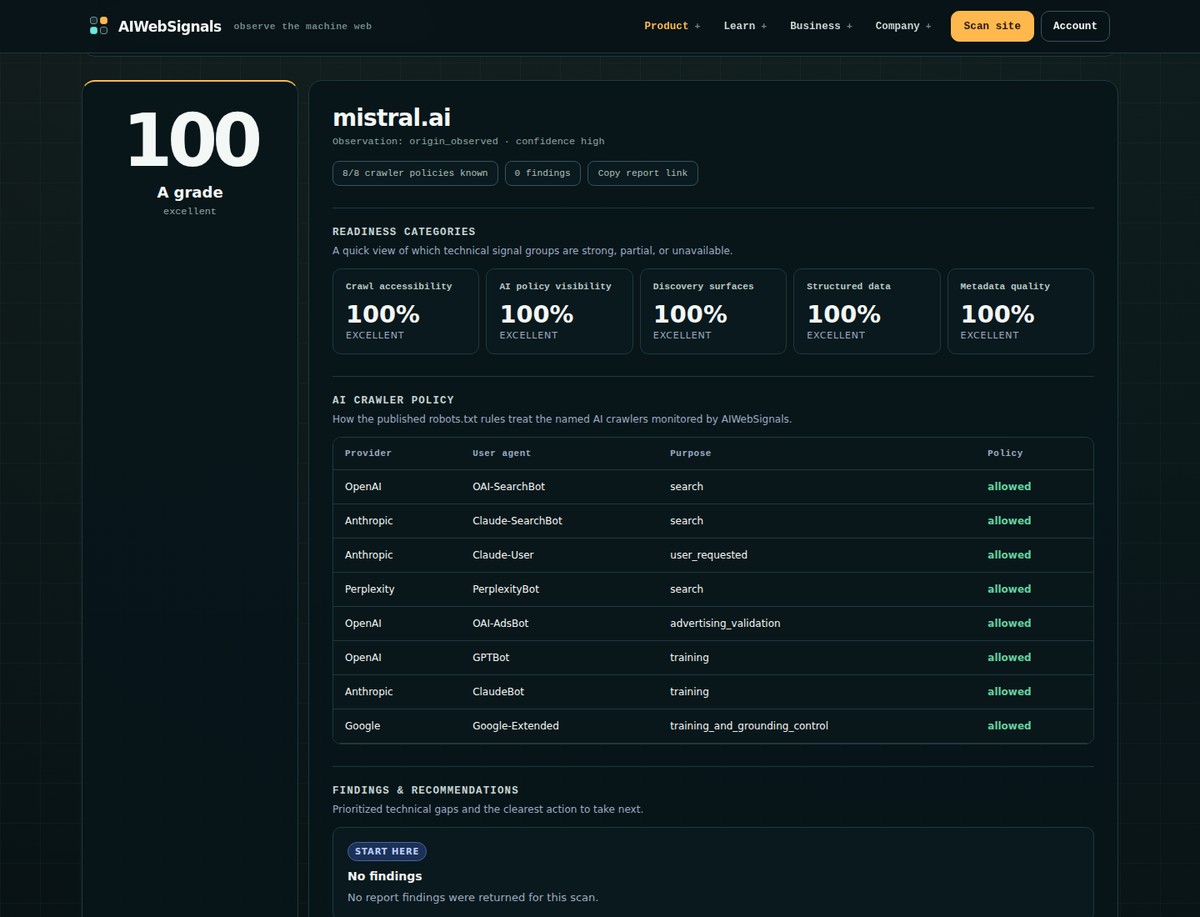
Mistral scored 100. Why was evidence coverage only 58%?
A concrete explanation of technical readiness versus evidence coverage, using Mistral’s October 2 public assessment and its 20 unknown checks.
Read the evidence and next step →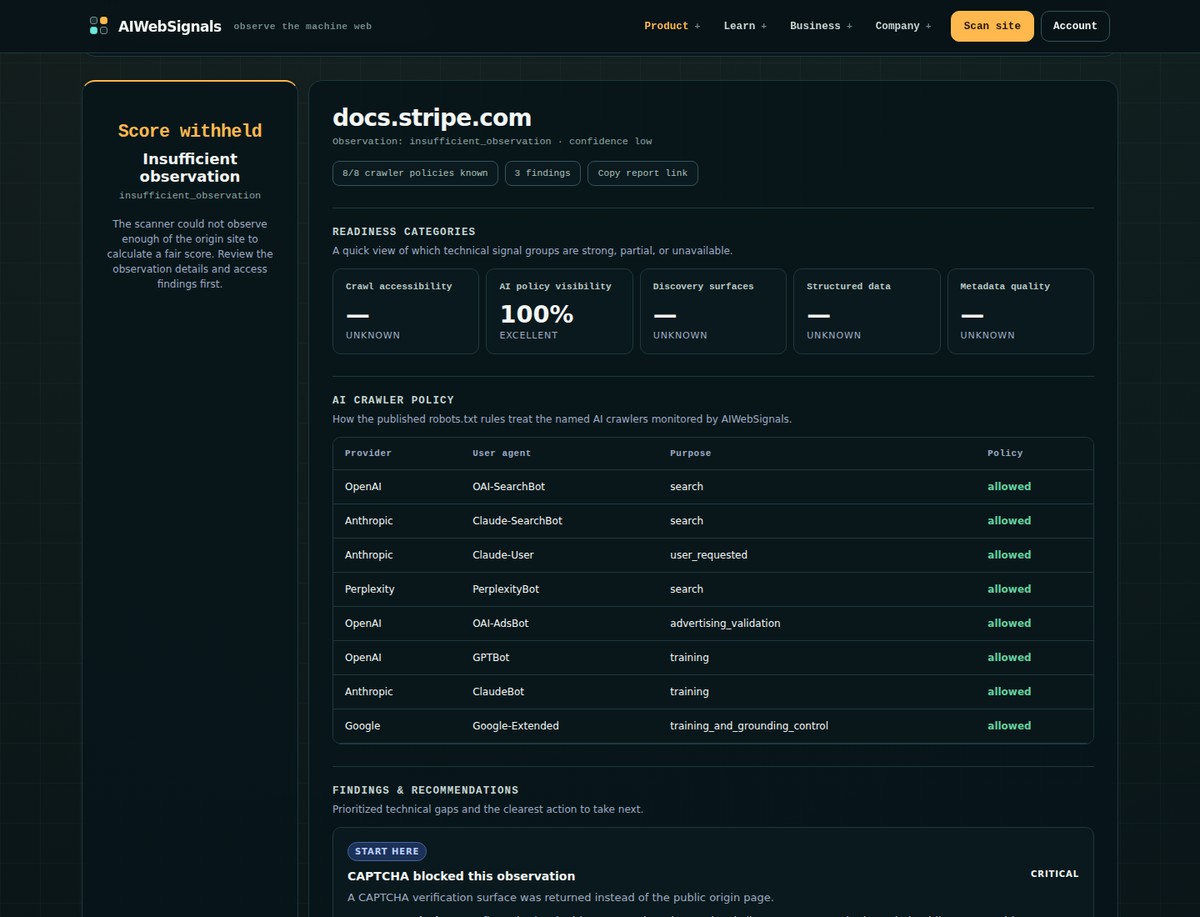
Stripe’s homepage and documentation produced different answers. Here is why that matters.
A 100/100 homepage result and a withheld documentation score show why hostname, response classification and inspection limits belong in every report.
Read the evidence and next step →We scanned 100 websites. A score was not always an answer.
99 reports, 55 numeric scores, 44 withheld scores: what a varied public-web sample teaches about evidence, access, and useful AI-readiness assessments.
Read the evidence and next step →